During our campervan trip through France in September, we spent our last day in Dunkirk, a place forever associated with one of the most extraordinary events of the Second World War.
With Remembrance Sunday approaching, it seems a fitting time to look back at our visit and remember not only the thousands of men rescued during Operation Dynamo, but also those who never made it home.
In May 1940, German forces swept through Belgium and northern France, leaving hundreds of thousands of British and Allied troops trapped around the port of Dunkirk.
With the German army closing in, the only possible escape was across the English Channel.
On 26 May, Operation Dynamo began. Organised by Vice Admiral Bertram Ramsay from Dover Castle, it brought together Royal Navy warships, merchant vessels and hundreds of small civilian boats, later famously known as the Little Ships of Dunkirk.
For nine days, ships crossed the Channel under constant threat from German aircraft and artillery, while soldiers waited on the beaches and along the harbour.
By the time the evacuation ended on 4 June, an astonishing 338,226 British and Allied servicemen had been brought to safety.
Although often remembered as a miraculous success, Dunkirk was also a military defeat. Many thousands of men were killed, wounded or taken prisoner, and enormous quantities of military equipment had to be abandoned. The British Expeditionary Force lost most of its vehicles, tanks and artillery, including around 64,000 vehicles and 2,500 guns, leaving the army severely depleted of equipment at a time when Britain faced the threat of invasion.
Our first stop was Dunkirk Town Cemetery, and it was probably the most moving part of our visit.
The Commonwealth war graves are beautifully maintained, with row upon row of headstones marking the final resting places of servicemen who lost their lives during both world wars.
But perhaps the most poignant were the graves of unidentified soldiers. Seeing so many headstones bearing simply the words A British Soldier of the 1939–1945 War, followed by Known Unto God, really brings home the human cost of war.


The cemetery contains 793 Commonwealth burials from the Second World War, 213 of them unidentified.
Yet even these graves tell only part of the story. Thousands of other men who lost their lives during the campaign have no known resting place at all, their names preserved instead on memorials to the missing.
At the entrance stands the impressive Dunkirk Memorial, commemorating more than 4,500 servicemen of the British Expeditionary Force who died during the 1939–1940 campaign, or subsequently in captivity, and have no known grave.


The Dunkirk Memorial to the Missing, bearing the names of more than 4,500 servicemen with no known grave, and the inscription acknowledging the gift of the cemetery land by the French people.
The memorial includes a beautiful engraved glass panel depicting scenes from the evacuation, with the names of the missing inscribed on the surrounding stone walls.
We were particularly interested to find names from the Royal Welch Fusiliers, a regiment with strong connections to our own part of North Wales.
It was especially moving to stand there reading those names and remembering that behind every one was a family waiting for news that, for many, never came.


From the cemetery we drove into Dunkirk, where we visited the memorial on the seafront dedicated to the French and Allied airmen, sailors and soldiers who sacrificed their lives during the Battle of Dunkirk in May and June 1940.
It is a reminder that Operation Dynamo involved far more than the British Army, with French troops in particular playing a vital role in defending the evacuation perimeter while the rescue continued.

We had hoped to see some of the wrecks left behind by Operation Dynamo, which can still be found along the nearby coastline.
At low tide, the remains of vessels such as the Crested Eagle, a British paddle steamer involved in the evacuation, emerge from the sands around Zuydcoote.
Unfortunately, the tides weren't in our favour, so that will have to wait for another visit.
Instead, we enjoyed a long walk along the seafront.
Looking out over the wide stretches of sand and across the Channel, it is difficult to imagine the scenes here in 1940.
Thousands of exhausted soldiers waited for rescue, often standing in long queues stretching across the beaches and into the sea, while German aircraft attacked from above.
Although the Little Ships have become one of the best-known parts of the story, most of the soldiers were actually evacuated from the harbour's East Mole.
Originally built as a breakwater to protect the harbour, rather than somewhere for ships to dock, it was to prove invaluable.
Captain William Tennant, the senior naval officer at Dunkirk, realised that large ships might be able to come alongside the mole, allowing soldiers to board directly rather than having to be ferried out from the shallow beaches in small boats.
It was an inspired decision. By using the mole as a makeshift boarding point, hundreds of men could be taken aboard much more quickly, dramatically increasing the number who could be rescued.
More than 200,000 soldiers were evacuated from the East Mole, making it one of the most important locations in the entire operation.
Towards the end of our walk, we took a path through a small park on our way back to the campervan and came across something we could very easily have missed.
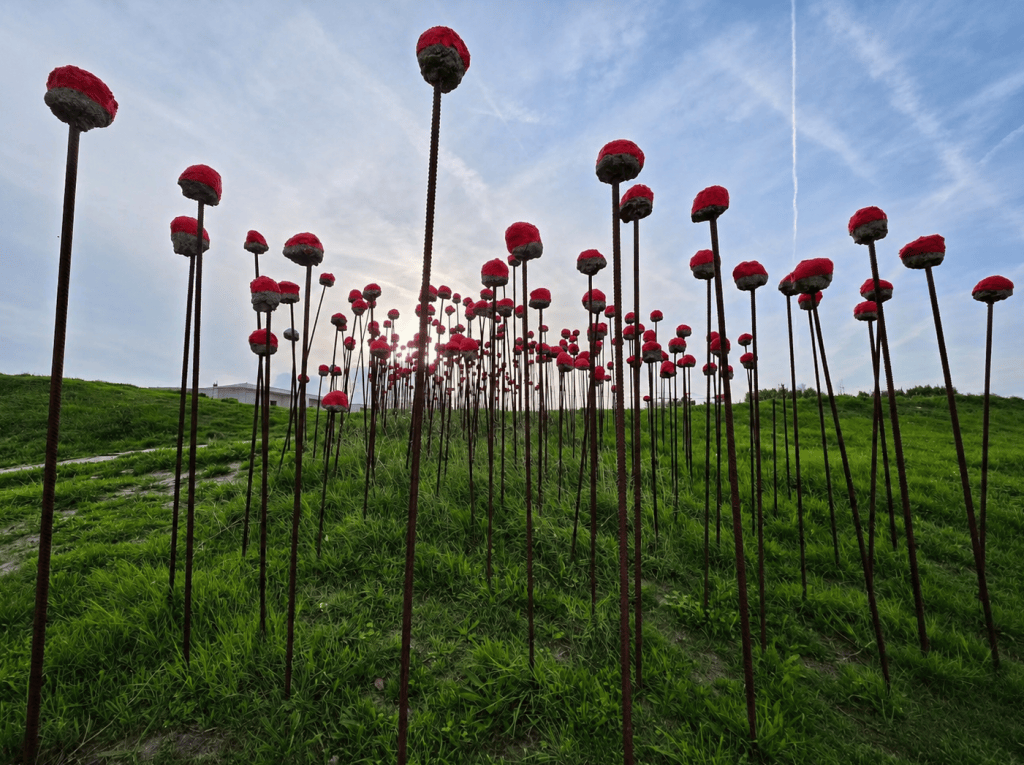
Standing amongst the grass was a wonderful installation of hundreds of red poppies, each mounted on a tall metal stem.

It was such an unexpected find, and particularly striking against the fading evening light. I took a photograph and returned the following morning, while out walking the dogs, to photograph them again in daylight.
The poppies were a memorable way to end our visit, in a town that had suffered so much during the war.
The evacuation of Dunkirk became a powerful symbol of courage, determination and survival, and helped give rise to the expression Dunkirk spirit.
The remarkable rescue of so many men became one of the most celebrated stories of the Second World War. We also remember those who lost their lives on the beaches waiting for rescue, and those who chose to remain behind to defend the retreat.
Visiting the cemetery and memorials, and then walking along the seafront where so much happened, gave us a much greater appreciation of the events of those nine days in 1940.
And as Remembrance Sunday approaches, it seems particularly important to remember not just the extraordinary rescue, but the thousands of men whose names remain carved in stone at Dunkirk.
We will remember them.